

It is no longer enough to just give women internet or phones. The goal is to ensure they have the power, skills, and freedom to benefit and make decisions using technology.
For much of the past decade, the conversation around digital inclusion in Africa has been framed in terms of access. More smartphones, more connectivity, more people coming online. And by many measures, the progress is real.
But when we recently conducted an in-depth survey with 500 women across eight West African countries, it became clear that access, while necessary, is no longer the most useful lens for understanding what comes after.
The more revealing question now is agency.
Across commerce, finance, health, and education sectors, women are already demonstrating strong motivation to use digital tools to improve their economic and personal outcomes. What remains uneven is whether the systems they encounter are designed for the realities they are navigating.
Motivation is not the missing piece
One of the most persistent myths in digital inclusion work is that underserved users are primarily constrained by lack of interest or awareness, or even access in some cases. However, our data tells a different story.
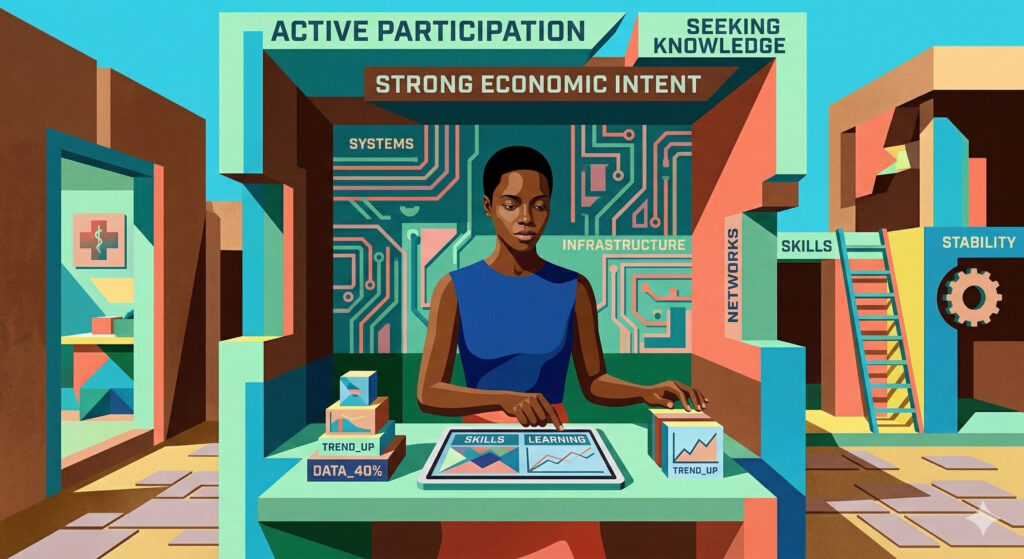
In Ghana, for example, 40% of women reported using their devices for learning or job search, underscoring the strong economic intent behind digital engagement. Similarly, in the health-focused data, 45% of respondents in Ghana reported using digital platforms for learning or studying, reinforcing the central role of knowledge-seeking behaviour in women’s digital journeys.
These certainly are not passive users waiting to be convinced, no, they are active participants, often using digital tools as stepping stones toward income stability, skills development, and improved wellbeing on the whole.
The gap, increasingly, is not motivation. Women are already motivated and trying to use digital tools, the real problem is that the systems, products, and support around them don’t always match their current realities.
The persistence of structural friction
Across our research findings, three constraints appear with striking consistency: affordability, trust, and income instability.
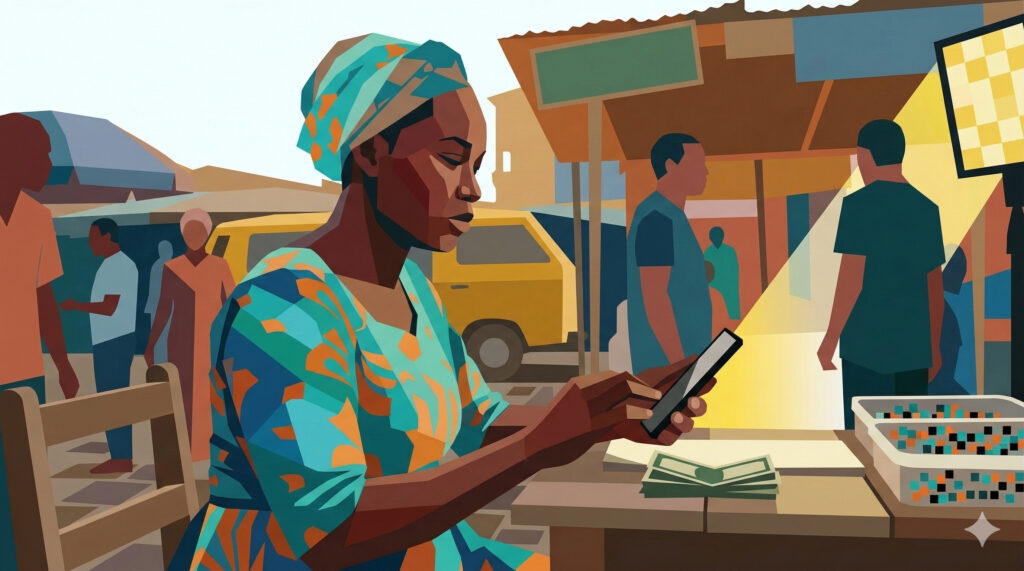
Data affordability remains one of the most immediate friction points. In Nigeria and Benin, large shares of women report that high mobile data costs limit their ability to engage consistently with digital platforms.
In health contexts, the pattern holds. Among Nigerian respondents, 64% identified high data costs as a major barrier to sustained use of digital platforms. For many women, digital participation is not a binary state of being online or offline. It is a continuous negotiation shaped by daily financial trade-offs.
Trust presents a parallel challenge. In our findings, concerns around scams and weak customer support continue to push some women back toward offline alternatives they perceive as safer.
And beneath both affordability and trust sits a deeper economic reality. Across countries, significant numbers of women report being unemployed or self-employed, highlighting the prevalence of informal and often unpredictable income streams.
Cumulatively, these factors suggest that many digital systems are still being built for users with more stable conditions than the real conditions many women actually experience.
From users to economic actors
One of the more important reframes emerging from the research is the role women are already playing within digital ecosystems. In the e-commerce data, high rates of self-employment across countries suggest that platforms are not only marketplaces for consumption but increasingly infrastructure for income generation.
When women engage digital platforms primarily as economic actors, to sell, learn, earn, and manage, their expectations shift. Reliability of the platform matters more, cost sensitivity increases, and the Trust threshold rises.
Designing for this reality requires moving beyond the language of “onboarding users” toward supporting economic engagement.
Privacy and dignity in the digital experience
The research also surfaces a more nuanced dimension of trust, particularly in health contexts.
Among peri-urban women in Nigeria, 58% prioritised privacy and security when choosing digital platforms. Importantly, the concern is not only about cyber threats. Shared phone usage remains common in many households, meaning privacy risks can be social and domestic as much as technical.
For women navigating sensitive health or financial decisions, the question is often not simply whether a platform is secure, but whether it is discreet.
This is where many otherwise well-designed solutions quietly lose relevance.
Cumulatively, these factors suggest that many digital systems are still being built for users with more stable conditions than the real conditions many women actually experience.
What a shift toward agency requires
If the next phase of digital inclusion is to move from access to agency, several shifts become important.
First and foremost, affordability must be treated as a core design consideration, not an external constraint. Lightweight online experiences, offline continuity, and flexible usage models directly influence whether motivated users can remain engaged.
Secondly, trust must be made visible and shown in experience. Clear possible courses of action, responsive support, and design that considers the contexts these women are in, are increasingly central to sustained adoption.
Thirdly, product thinking must embed the women’s’ economic realities. Factors such as irregular income, informal work, and multi-role lifestyles are not edge cases, they are common patterns shaping how many women interact with digital systems.
A more durable path forward
West Africa’s digital momentum is real and accelerating. But if inclusion efforts remain focused primarily on expanding access, they risk plateauing just as deeper participation becomes possible. The more durable path forward lies in designing systems that expand women’s agency, that is their ability not just to access digital tools, but to use them confidently, consistently, and on their own terms.
The women are already journeying along. The question now is whether the systems around them will evolve quickly enough to meet them where they are.