


It lasted less than a minute.
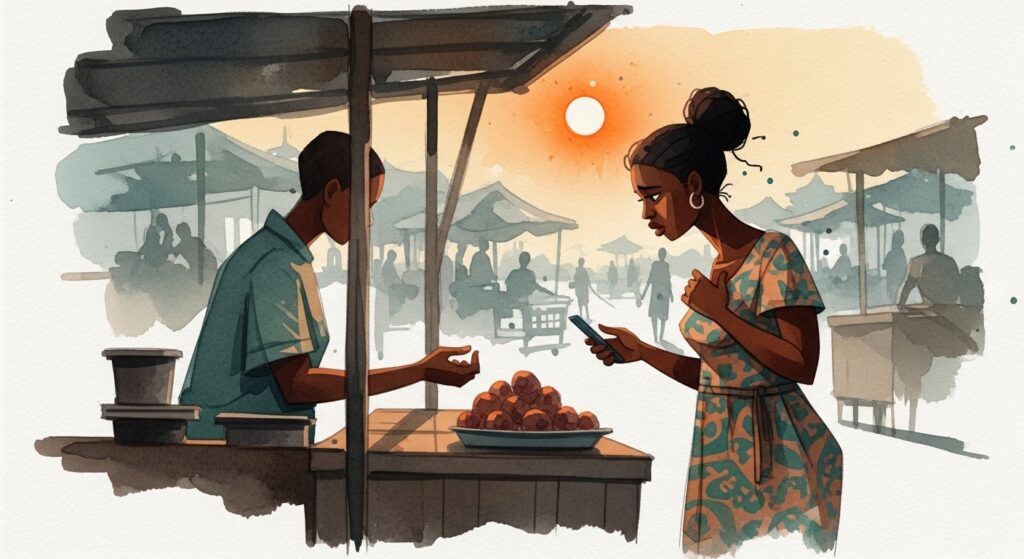
A market trader in Lagos had just made a transfer through her digital wallet for the first time. The money left her balance instantly. The confirmation screen stalled. No SMS. No immediate receipt.
She refreshed. Nothing.
In that suspended moment, she wasn’t thinking about product innovation or embedded finance. She was thinking, “Is my money gone?”
That moment, that thin slice of uncertainty, is where African fintech wins or loses.
The Account Ownership Paradox: Strong Numbers, Weak Engagement
There is real progress to acknowledge. According to the World Bank’s Global Findex data, account ownership in Sub-Saharan Africa has more than doubled over the past decade, reaching around 55% of adults by 20211. In Nigeria, formal financial inclusion rose from 56% in 2020 to 64% in 2023, according to EFInA’s 2023 Access to Finance survey2.
From the outside, the trajectory is clear: more accounts, more digital rails, and more funding, with Sub-Saharan Africa posting the fastest global growth in account ownership between 2011 and 20211. But the data also reveals a quieter tension. A significant share of excluded Nigerians still cite lack of trust in financial institutions as a primary barrier. Even among those with accounts, inactivity and partial usage remain common3.
Account ownership is measurable. Trust is not.
And yet trust is what determines whether a user leaves more or less in their digital wallet.
Why Trust in Nigerian Fintech Is Structurally Fragile
In many African markets, distrust is not irrational. It is inherited. Users have lived through failed banks, frozen accounts, cooperative society collapses, and highly publicized Ponzi schemes, such as the popular MMM Nigeria, which is estimated to have wiped out between ₦12 and 18 billion in savings when it collapsed in 20164. They have seen policies change abruptly. They have experienced transfers that disappeared for days before reversing; these experiences have deepened skepticism toward formal financial actors.
In more stable economies, a failed transaction is inconvenient. In lower- and middle-income African contexts, it can destabilize an entire household.
This is why risk perception is amplified. Loss aversion operates more intensely where financial buffers are thin.
When a fintech user hesitates before confirming a transfer, they are not assessing your design system. They are assessing survival.

Trust as a Revenue Multiplier
For venture firms and DFIs, trust should be examined as a core performance variable.
Because when trust increases, behavior changes. Users consolidate funds instead of fragmenting them, experiment with new features rather than avoiding them, accept automated deductions, and refer peers even without incentives. Credit repayment improves because the relationship feels reciprocal rather than extractive. Trust compounds quietly but powerfully.
Regulators such as the Central Bank of Nigeria have strengthened oversight and issued consumer protection frameworks and regulations for digital financial services to stabilize the ecosystem and safeguard consumer assets5, yet compliance alone does not translate into perceived safety. Trust is not just built through circulars and policy announcements. It is built through consistent, transparent interactions.
How DODO Diagnoses and Builds Trust Systematically
At DODO, we approach trust as a measurable design variable: observable, diagnosable, and improvable through structured research and intentional product intervention.
For fintech-focused engagements, we map emotional volatility across the user journey. The question is not simply where users drop off, but where anxiety spikes: at the first deposit, at the first large transfer, at a failed transaction, or at a loan approval decision. These moments deserve rigorous design attention, not just UX optimization.
We conduct participatory testing, contextual inquiry, and longitudinal observational studies in real usage environments because surveys cannot capture the behavioral suppression that distrust produces. Identifying where trust breaks in your users’ journey unveils a potential growth opportunity.

The Competitive Advantage Ahead
The next phase of African fintech will not be determined solely by who ships features fastest.
It will favor companies that reduce perceived risk systematically. Companies that understand that in volatile economic environments, safety is more compelling than sophistication.
Features may drive downloads. Trust drives retention, and retention drives profitability.

The Lagos trader eventually received her confirmation message. The transfer succeeded.
But what determined whether she would use the platform again was not just the technical success of the transaction. It was how the product held her or failed to hold her in those fragile seconds of uncertainty.
Global and regional data make the pattern clear: account numbers can rise while usage lags if people still hedge by keeping value offline or spreading balances across providers because they are unsure who to trust6. Trust is not an accessory to growth. It is the engine.
References
- CGAP (2022). Findex 2021 insights: Boosting financial inclusion in Africa.
- Lagos Business School Sustainable and Inclusive Digital Financial Services Initiative (2023). A2F 2023 survey: Unlocking insights to accelerate financial and economic inclusion.
- International Monetary Fund (2023). Nigeria: Fostering financial inclusion through digital financial services.
- Fintech Magazine Africa (2025). The Ponzi schemes in Nigeria: A history of exploitation.
- Goldsmiths Solicitors (2025). Why digital payment platforms must align with CBN guidelines.
- World Bank (2025). Financial inclusion in Sub‑Saharan Africa: Progress and obstacles.