


During a field interview in Lagos, a merchant reached beneath her counter and pulled out a small plastic container filled with cash.
She owned a smartphone. She had a bank account. She regularly received digital payments from customers.
“If the network fails, she said, I can still run my business.”
This moment is not an edge case. In markets where digital infrastructure is advancing rapidly but behavioral trust is lagging far behind, it is a pattern replicated across millions of transactions.
For growth-oriented institutions, this trust gap represents a significant barrier to market expansion and program reach in the world today.
The question is not whether consumers can use digital money. Increasingly, they can. The question is why, even when they can, so many still choose not to and what it costs institutions that have not yet understood why.
Digital Payments Are Growing, But Cash is still trusted
Nigeria’s formal financial inclusion has expanded significantly over the past decade. According to the EFInA Access to Financial Services Survey1, the share of Nigerian adults using formal financial services has grown steadily, driven by mobile banking, USSD platforms, and agent banking networks.
The World Bank Global Findex Database2 similarly documents accelerating digital payment adoption across Sub-Saharan Africa. On those headline numbers, the story appears to be one of progress.
But headline adoption figures mask a more complex behavioral reality.
A large share of digitally-registered users receive income digitally, then immediately convert it to cash. Everyday transactions, market purchases, transport fares, and informal service payments remain overwhelmingly physical. Digital accounts are treated as conduits, not as primary financial instruments.
This matters enormously for institutions trying to model addressable markets, design product roadmaps, or project program reach. The effective market for digital financial services is substantially smaller than registered-user numbers imply because registration does not equal trust, and trust does not equal habitual use.
Nigeria’s 2023 naira redesign crisis made this visible at national scale. When the CBN withdrew high-denomination notes, and ATM networks could not keep pace, daily commerce did not smoothly migrate to digital channels. Instead, it contracted. Markets stalled. Small businesses lost revenue. Queues formed at bank branches across the country.
The episode revealed something important: for millions of Nigerians, digital money was available but not sufficiently trusted as a standalone system. Cash was not being held out of ignorance or technological incapacity. It was being held as insurance against network failures, platform outages, and institutional uncertainty.
Data from CBN’s on the crisis, alongside reporting from sources such as The Cable3 and BusinessDay4, documented widespread economic disruption, not because Nigerians lacked access to digital tools, but because those tools had not yet earned the behavioral trust that cash has accumulated over decades.
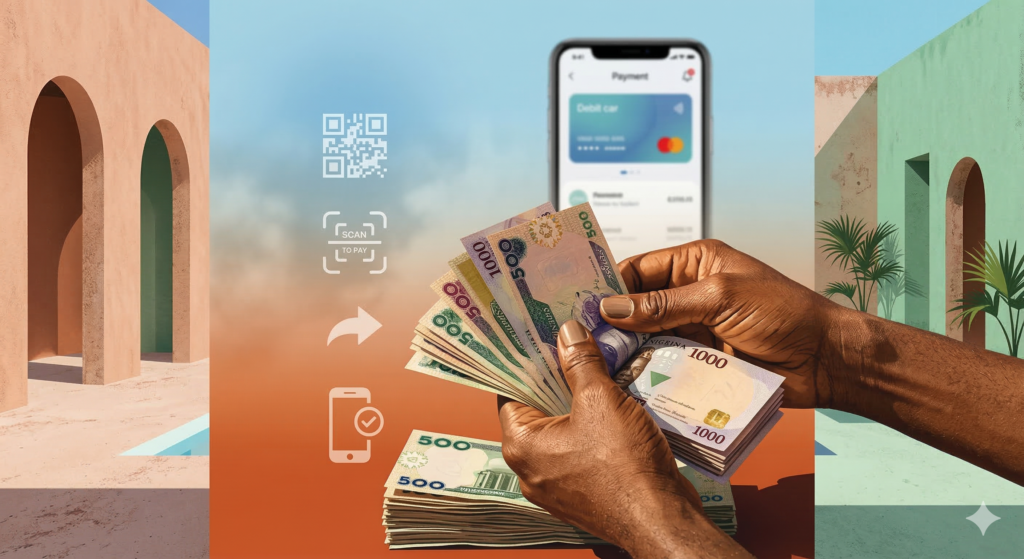
Behavioral Mechanisms That Foster Cash Transactions
1. Cash Provides Immediate, Tangible Control
Physical money offers something that digital systems structurally struggle to replicate: certainty without an intermediary. When you hold cash, you know exactly what you have. You can spend it instantly. No app, no network, no institution stands between you and your transaction.
Digital money, by contrast, is experienced as abstract. It exists inside a platform, subject to connectivity, platform reliability, and institutional performance. Even brief disruptions, such as a failed transfer, a delayed reversal, a frozen account, interrupt that experience of control. And even when disruptions are rare, the perceived possibility of them shapes everyday behavior.
2. Abstraction Undermines Trust: The Psychology of Digital Money
Behavioral economists have documented a phenomenon known as money abstraction, the tendency for digital or abstract money representations to feel less real, less regulated, and less reliable than physical currency. When financial systems remove tangible cues, users lose the psychological anchors that ordinarily govern financial decision-making.
This is not a literacy problem. Highly educated, digitally literate users exhibit the same patterns. It is a design and trust problem. Digital platforms have largely inherited the transaction logic of physical banking without redesigning the psychological experience of holding, spending, and trusting money.
The result: users who receive digital transfers quickly withdraw them as cash, not because they reject digital systems, but because cash feels more like money.
3. Trust Is Built Socially, Not Through Marketing
Psychologist Robert Cialdini’s foundational research on social proof5 demonstrates that individuals evaluating unfamiliar systems rely heavily on observed peer behavior, not institutional assurances.
In Nigerian payment markets, this dynamic plays out in ways that are highly predictable once you look for them. Platforms that embedded digital transactions inside existing social networks, market associations, transport unions, and neighborhood commerce, achieved rapid adoption not primarily through advertising. When enough members of a trusted community adopted a platform and were seen to receive money reliably, trust transferred.
USSD-based banking, dialing bank codes reached Nigeria’s lower-income population not because it offered superior technology, but because it worked offline, required no smartphone, and rapidly built social proof in communities where smartphone penetration was limited. It remains one of the most instructive case studies in trust-first design in any emerging market.

Behavioral Design Principles That Work
- Visible transaction assurance: Clear confirmations, real-time status updates, and accessible recovery pathways reduce the anxiety associated with digital transfers and are strongly correlated with repeat usage.
- Resilient, offline-compatible experiences: Systems that function during network instability as USSD does, signal institutional reliability in ways that app-only experiences cannot replicate in markets with inconsistent connectivity.
- Community-embedded adoption: Peer demonstrations, merchant network onboarding, and social proof accumulation through community channels consistently outperform direct marketing in building behavioral trust at scale.
- Trust-first product sequencing: Introducing new financial products and features to existing, trusted user segments first before mass rollout allows social proof to build organically before the product reaches communities where trust is more fragile.
The Strategic Opportunity: Behavioral Trust as a Competitive Edge
Cash has persisted for centuries because it satisfies fundamental human needs: certainty, control, and visibility. It requires no institution to validate it and no network to transmit it.
Digital payment systems will achieve genuine behavioral adoption not just registered users, but habitual daily use, only when they convincingly replicate those same psychological properties. The organizations that understand this will design systems people choose, not systems people tolerate when cash is unavailable.
For Nigerian fintechs, this represents a significant competitive opportunity. For foundations and multilaterals, it is the difference between programs that achieve their intended reach and programs that reach the easy-to-reach while leaving the most vulnerable populations behind.
The institutions best positioned to capture this opportunity are the ones that invest in understanding how people actually experience money, in markets, in households, in the informal social environments where financial trust is built and lost every day.
The trust gap is not a failure of digital payments. It is a market signal. And for the institutions that know how to read it, it represents one of the most significant growth opportunities in emerging-market finance today.
Sources and Further Reading
- EFInA Access to Financial Services in Nigeria Survey
- World Bank Global Findex Database – Digital Payments Data
- The Cable – Nigerian Fintech and Policy Reporting
- BusinessDay Nigeria – Naira Redesign Coverage
- Robert Cialdini – Principles of Persuasion (Social Proof)